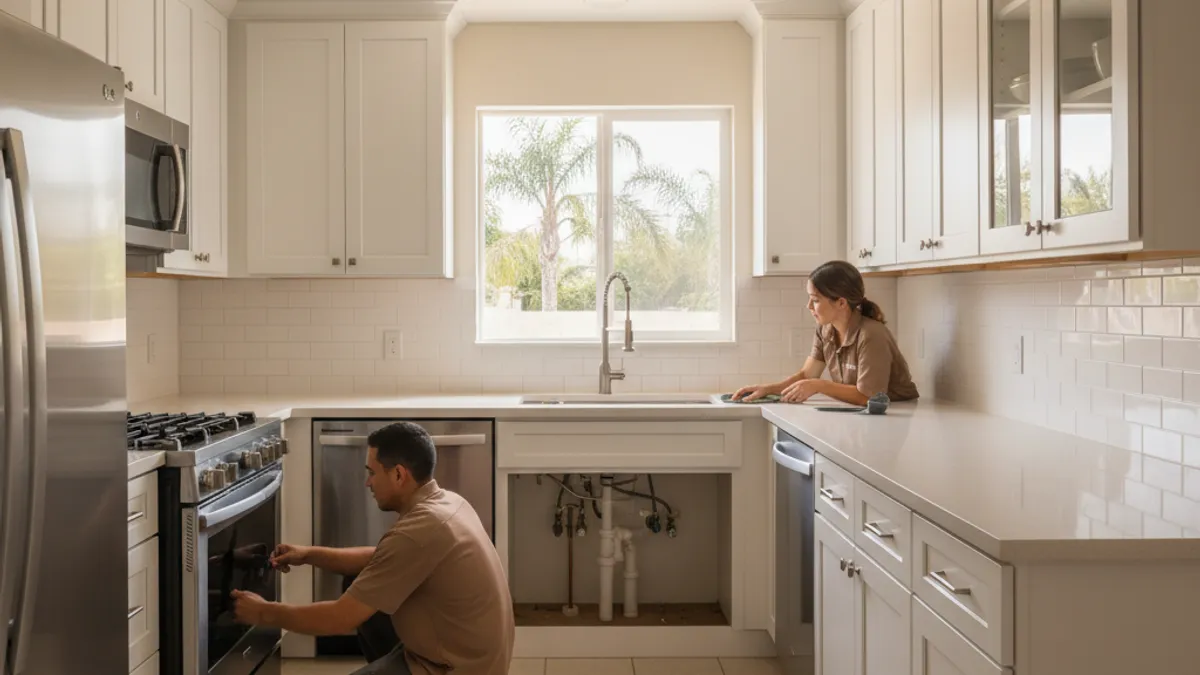
A galley kitchen is two parallel runs with a walkway between them. The layout works when that walkway still functions after doors, drawers, and a second person are in the way. It fails when the plan is copied from a photo. Measure the room first. Then pick fixes that fit those numbers.
The National Kitchen & Bath Association Kitchen & Bath Planning Guidelines are the planning reference used below. They are recommendations for designers, not California building code and not a permit. The project drawings, product documents, and the local reviewing authority still control what gets built.
Start with a measured-layout worksheet
Record inches, not guesses. A compact galley in City Heights and a wider one in El Cajon can share a name and need different plans.
1. Room width. Measure wall to wall, or obstruction to obstruction, at counter height.
2. Each run’s occupied depth. Use the cabinet spec sheet plus the actual counter overhang on the drawing. Don’t assume a number from memory.
3. Clear aisle. Subtract both occupied depths from the room width. That remainder is the aisle between counter fronts.
4. Door and drawer swings. Open the refrigerator, oven, dishwasher, and any pantry. Mark the swing on the floor with tape. Note collisions with the opposite run.
5. Ends of the galley. Note whether each end is a wall, a doorway, a window, or an opening to another room.
6. Height. Record ceiling, soffits, and the underside of existing wall cabinets.
7. People test. Walk the taped aisle with a laundry basket. If two people cook, have both stand at the sink and range at once.
A labeled example, not a rule for your house:
WALL |  RUN A (measure)  |  AISLE  |  RUN B (measure)  |  WALL
     |<------ Da ------->|<-- C -->|<------ Db ------>|
Room width W = Da + C + Db
If W is 120 inches and each run occupies 24 inches of depth, C is 72 inches. If W is 96 inches with the same runs, C is 48 inches. Those two rooms should not get the same island, peninsula, or shelf plan.
NKBA Kitchen Planning Guidelines recommend a work aisle at least 42 inches wide for one cook and at least 48 inches for multiple cooks, measured between counter frontage, tall cabinets, and appliances. They recommend a walkway at least 36 inches. If the aisle is only a pass-through, 36 inches is the planning starting point. If people prep on both sides, use the work-aisle figures. Your household and the reviewer can require more.
Four problems to test, not four universal failures
Traffic. Two cooks, one aisle, and three appliance doors will collide if the hot zone and the cleanup zone stack on the same side. Put the range and the sink on a plan, then open every door. A “hot wall / cold wall” split is an option when the aisle is tight. It is not mandatory.
Storage you can reach. Catalog wall cabinets are often sold around 12 inches deep and base cabinets around 24 inches deep. Measure the boxes in the room. Full-extension drawers make the back of a base cabinet usable. A tall pull-out pantry is an option at the end of a run when a separate pantry closet doesn’t exist. A corner pull-out is an option when a blind corner wastes the end of a run. Don’t treat any of those as a capacity percentage. Ask the cabinet line for the internal dimensions of the exact SKU.
Light. A single ceiling fixture at one end of a long galley leaves the other end in shadow. That is a layout observation, not a lighting code. Mock the plan with temporary lamps. Title 24 lighting details are not confirmed in this site’s claims ledger. Have the electrician and the reviewer confirm the current requirements.
Connection to the next room. Opening an end wall can turn a closed galley into a U or an L with a peninsula. It can also hide structure, ducts, or wiring. Don’t assume a wall is non-load-bearing because the neighborhood is older. Have the licensed professional inspect it. Building permits may be required depending on the scope. For a City of San Diego property, contact Development Services at 619-446-5000. Other county cities use their own building department.
Layout options that can fix a measured galley
Use these as a menu. Keep the ones the worksheet supports.
Open one end, if the structure allows. A peninsula can add seating or prep without dropping a furniture-sized island into the aisle. Confirm structure, flooring patches, and finish scope in writing.
Swap doors for drawers on the prep run. Reach beats hidden back corners. Price the exact drawer boxes, slides, and interiors. A San Diego average for that swap could not be confirmed.
Add a tall pull-out at one end. It uses vertical space the aisle doesn’t have.
Change the corner hardware. A blind corner, a lazy Susan, and a pull-out are different products. Pick from the cabinet manufacturer’s current hardware list.
Take wall cabinets higher, if the ceiling and the spec allow. Unused volume above a standard wall cabinet is common. Dust, reach, and filler panels still need a drawing.
Skip a centered island when the aisle math fails. See the example in the kitchen island design guide. A rolling cart you can park is an option. A peninsula is often the better attached surface. Compare both with our island vs peninsula page.
Open shelving is an option, not a moral failing. Opposite a range, shelves collect grease and show every dish. Closed doors hide that. If you want shelves, put them on the wall that stays cleaner and keep a closed run at the cooktop. Don’t install them to “make the galley feel bigger” and then treat cleaning as a surprise.
A paint-and-counter refresh is also an option. It will not widen the aisle. If the worksheet shows a traffic problem, finishes-only work leaves that problem in place. A phased plan can do layout first and finishes later.
Color, counters, and light as tests
Light-colored cabinets and a continuous counter can bounce more light down a narrow room. Dark, high-contrast surfaces can make the same aisle feel tighter. That is a visual test, not a San Diego trend report. Tape samples on both runs. Photograph them morning and night.
Under-cabinet lighting belongs in the same test. Hold the tile or counter sample under the planned fixtures, not only in a showroom. Don’t lock a Kelvin number from memory. Confirm the fixture with the electrician and, where energy rules apply, with current California Energy Commission guidance at energy.ca.gov.
A small mirror or a glass door is one reflective option. One is enough to try. A galley paneled in mirror is a different project.
What the quote should itemize
A typical San Diego galley remodel price band could not be confirmed. Don’t use a blog total as a budget. Ask each bidder for the same measured plan. The written scope should name:
- Design drawings and revisions
- Demolition and disposal
- Cabinets, interiors, and fillers
- Countertops, edges, and seams
- Appliances, including counter-depth or built-in models if the aisle needs them
- Plumbing and electrical work
- Backsplash and flooring
- Paint, trim, and patches
- Wall opening, beam, or no wall opening
- Permit responsibility when permits apply
For home improvement contracts covered by California Business and Professions Code §7159, the down payment is capped at $1,000 or 10 percent of the contract price, whichever is less.
The galley kitchen remodel page has the service checklist. If an end wall is in play, read open concept kitchen. For a full gut, see full kitchen remodel.
What to ask a galley remodeler
- Will you measure aisle, swings, and ends on site before you draw?
- Which NKBA planning figures are you using as a starting point, and where does this plan depart from them?
- Do you recommend opening a wall only after you see the structure?
- Are base cabinets drawers, doors, or a mix, and can I see the SKU dimensions?
- Who pulls any required permit, and who should I call at the city?
Verify the firm on the CSLB License Check. License status is legal status, not a workmanship grade.
When to call us
Call when a galley needs a measured plan, cabinet changes, a possible wall opening, or a licensed kitchen remodeler to price the real aisle. Building permits may be required depending on the scope. Call us at (858) 400-4623 and we’ll connect you with a licensed local kitchen remodeler.