Wood looks calm in a catalog photo. In an Encinitas kitchen it sits under a west window, next to a sink that never stays dry, and in a marine layer that keeps indoor air damp for hours. That is the honest butcher block countertops question in San Diego County: which wood, where it goes, and whether you will keep oil on it when the fog rolls in.
Wood species and how they actually wear
Butcher block is glued hardwood strips, not a single board from one tree. The mill chooses the species, the grain orientation, the glue, and the finish. Those four choices decide how the top marks, moves, and ages in a real kitchen.
Maple is the common closed-grain workhorse. It takes knife marks in a pale, even way and does not show open pores the way oak does. Walnut is darker and often a little softer under a chef’s knife. It also fades where Encinitas and Pacific Beach sun hit it every afternoon. Oak and ash show a stronger grain. Food and oil can sit in those open pores if the finish is thin. Acacia and rubberwood show up in many big-box slabs. They can look fine on day one. Ask the mill what the strips actually are, and what finish ships on them, before you treat a box-store slab like a custom top.
Grain orientation changes the wear pattern. End grain stands the strip ends up, so you see a checker of small squares. Knife cuts land in those end fibers and are easier to sand later. Edge grain shows the long side of each strip in a linear field. It is the look most people mean when they say wood kitchen countertops. Face grain uses the wide face of the board. Scratches read as long scars, and it is a weaker cutting surface if you planned to chop on the island.
None of that makes wood invincible. A hot pan leaves a pale ring. A dark berry stain sits in unfinished pores. A cheap film finish can peel at the sink. A well-oiled hard maple island in Carlsbad can look better at year five than a neglected walnut wet wall in a west-facing Pacific Beach condo. Species is the start. Use and sun finish the story.
If you want a printed, wipe-down surface instead of a living wood one, read whether laminate countertops are worth it for the same run of cabinets. Laminate and butcher block solve different kitchens. Mixing them (wood on the island, laminate on a laundry-adjacent wet bar) is a real plan, not a compromise.
Confirm the species, thickness, glue line, and factory finish in writing with the mill. The kitchen countertop installation pro we connect you with should see that sheet before they cut a sink or a cooktop.
Oil, water and the sink zone
The downside of butcher block is not mystery. It is water that sits, heat that scorches, and oil that you skip. Wood is not stone. A dripping colander, a wet sponge nest, and a slow leak at the faucet flange will raise grain, darken the glue line, and open a gray halo around the sink.
Food-safe mineral oil, oil-and-wax blends, and film finishes (varnish, conversion varnish, some two-part coatings) are different products. An oil finish soaks in and needs refresh. A film finish sits on top and can chip or cloud if water creeps under it. Searchers ask about a “7 rule” for butcher block. Mills and finish makers often start a new oil-finished top on a short, frequent oiling cadence in the first weeks. The exact days, the product, and whether you oil or wax are specific to that mill and that finish. Confirm the schedule in writing with the mill and the installer. Do not copy a generic internet calendar onto a coastal Encinitas top and call it done.
Keep the sink zone honest. If the wood runs to an undermount sink, the cutout is the failure point. Water collects on the reveal. End grain at the cut drinks faster than the field. The fabricator should finish that cut on all edges, not only the top face. A drop-in sink with a rim that sheds water onto the wood is not kinder. It just hides the stain until you pull the sink.
Cleaning is plain. Wipe crumbs, wash with a mild soap, dry the surface. Do not leave raw meat juice on an oiled top. Do not soak the wood to “disinfect” it. If a mill specifies a food-contact finish, follow that product. If they specify a film finish that is not a cutting surface, use a board. Vinegar, lemon, and salt show up in casual care tips. They can also dry or etch a finish. Ask the mill before you experiment.
Standing water is the real enemy, not the idea of wood. A butcher block island San Diego homeowners actually keep is one they wipe and oil. A butcher block wet wall they regret is one they treated like quartz.
Coastal humidity in Encinitas and Carlsbad
San Diego County is not one climate. Encinitas, Carlsbad, Leucadia, and Pacific Beach sit in marine-layer air for much of the year. Indoor humidity stays higher. Salt is in the breeze. West windows cook the same top that the fog dampened that morning. Inland North County and East County run drier and hotter. A wood top in El Cajon fails from sun and heat more than from fog. A wood top in Encinitas fails from moisture cycles.
That cycle is why a swapped-city blog post does not help you. Wood moves across the grain as it takes on and gives off moisture. In a tight Encinitas cottage with windows shut against the May gray, a new slab can cup if it was stored dry and then lived wet. In a Carlsbad great room with afternoon sun on a dark walnut island, the top can check and fade while the sink side stays pale and swollen.
Ask the mill what moisture content they target for coastal Southern California interiors, and how they acclimate the slab. Ask the installer where the top will sit for a few days before it is fastened. Fastening a wet slab to dry cabinets (or the reverse) is how you get a proud seam in August. Leave expansion at the walls and at the cooktop ring. The installer should not glue every inch of a long run as if it were a quartz slab.
Sun is the other coastal factor. Pacific Beach condos and Encinitas kitchens with glass toward the water will bleach walnut and warm maple. A film finish yellows. An oil finish needs more frequent work on the window side than on the hall side. If the room is that bright, wood still belongs on an island that you can sand. It is a poor choice as a full-perimeter top you cannot rotate or refinish without emptying the kitchen.
Salt air does not “eat” a well-finished interior top the way it etches unprotected metal outside. It does keep surfaces tacky with film, and it rewards people who wipe. If you will not wipe, pick a different material.
Building permits may be required depending on the scope of work, especially if the island gets a sink, a dishwasher, or new circuits. For City of San Diego projects, start with Development Services and confirm the current rule for your address. Encinitas and Carlsbad have their own counters. Do not guess from a blog.
Seams, spans and the island use case
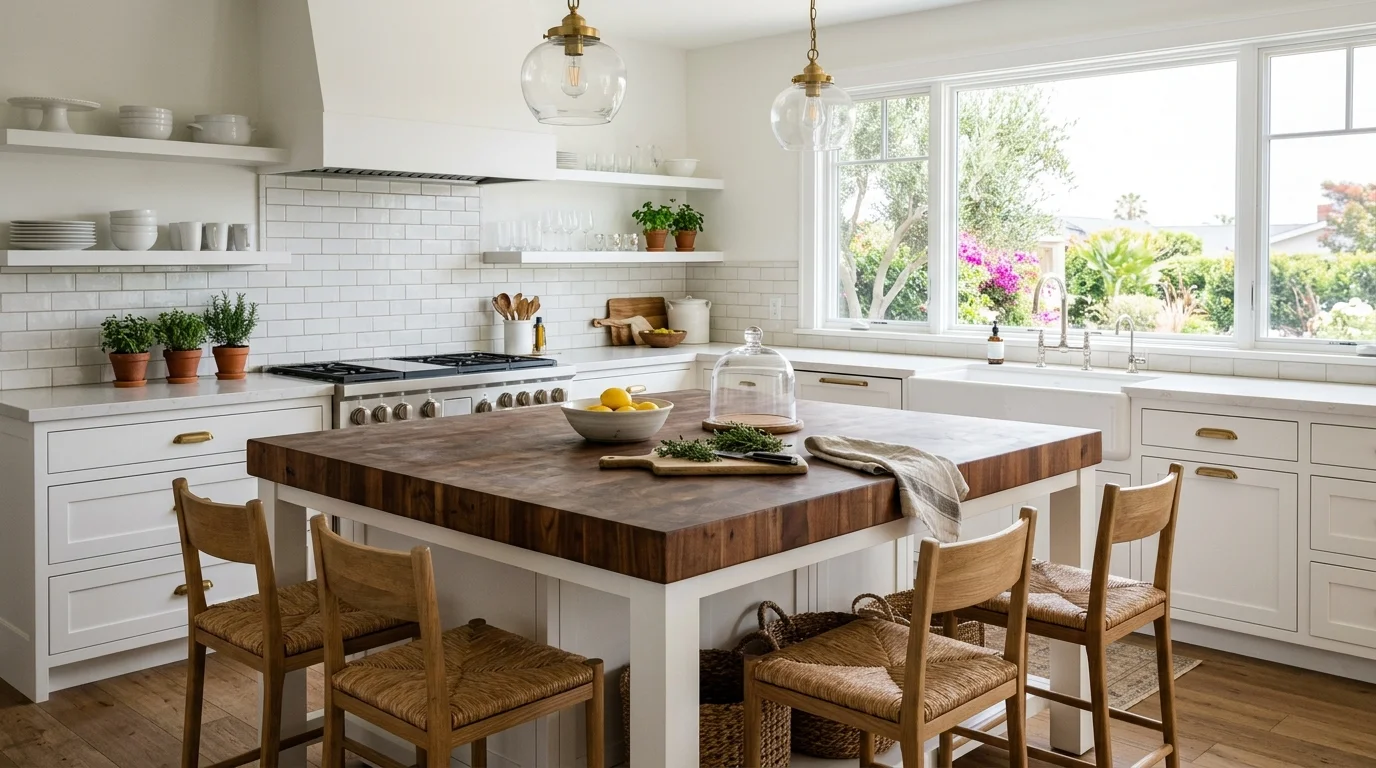
The best butcher block island San Diego kitchens use is a prep and dining surface, not the whole kitchen. Wood warms white shaker boxes. It feels like a table when guests stand there with a cutting board and a glass of wine. It also spans only as far as the mill, the glue, and the cabinet box allow.
Long runs need seams or a very large glue-up. Seams in wood are not the near-invisible joints you get in a well-done quartz kitchen. They telegraph if the two pieces move differently. Put seams out of the main chop zone and off the sink cut when you can. On an island, a single-piece top is the clean look. Confirm the mill’s maximum glue-up for your species and thickness. Do not assume a 10-foot island is one board because a mood board showed one.
Thickness and support matter more than the Instagram edge. A thick edge can be a built-up apron. The field behind it may be thinner. Overhangs for stools need real blocking in the kitchen island build, not a cantilever of glue and hope. The remodeler we connect you with should coordinate the box, the overhang, and the slab. Wood is lighter than stone, which helps on older Encinitas floors. It still needs a flat, true base. A twisted cabinet run will leave a ridge you will feel every time you wipe.
Mixed material is the grown-up San Diego plan. Stone or quartz on the wet wall and range wall. Butcher block on the island only. You get the warmth where people gather and a wipe-down surface where water lives. That layout also lets you refinish the island without tearing out the sink.
If the island gets a second sink, treat that cut like the main sink: finished edges, a tight reveal, and a care sheet. If it gets no sink, you just removed the main failure mode. That is why so many coastal kitchens keep wood on the island and leave the perimeter in slab.
When a stone or quartz slab is the better call
Butcher block vs quartz is not a style contest. It is a use contest. Quartz and granite win when the surface has to ignore you. Guest houses, short-stay rentals, households that set a hot pan down, kids with markers, and anyone who will not oil a top should not buy wood for the wet wall.
Quartz is even, non-porous in normal kitchen use, and unforgiving of a red-hot pan. Granite takes heat better in many kitchens and still needs its own care. For the slab-to-slab comparison, read quartz vs granite countertops before you lock the island in wood and the perimeter in something you have not priced. Installed price for butcher block versus granite is not a figure we can publish here. Species, thickness, edge, sink cutouts, finish, and the fabricator’s quote all move the number. Confirm a written price for your layout with the mill and the installer. A rare walnut glue-up can land in the same conversation as stone. A simple maple island can land lower. Treat any internet per-square-foot range as unverified until your quote exists.
Wood is still specified in 2026 because it photographs warm and feels like furniture. That is a taste call. It is not a durability ranking. If you want one material that does every job, pick a slab. If you want a kitchen that feels like a coastal Encinitas house instead of a showroom, wood on the island is still a fair call, as long as you budget time, not only money.
Skip butcher block when the top is the only landing for a kettle, when the sink is the whole counter in a small Pacific Beach galley, or when you already know you will not maintain it. In those rooms, the honest move is quartz, granite, or another slab the fabricator can seam and seal.
Hire on license, not on a pretty sample. California homeowners can verify a contractor on the CSLB License Check by license number, business name, or personnel name. License status is legal status. It is not a review of the last island they set.
When to call us
Call when you want wood on an island, a mixed-material kitchen, or a full counter run and you need a licensed local remodeler to coordinate the mill, the cabinets, and the install. Call us at (858) 400-4623 and we’ll connect you with a licensed local kitchen remodeler.