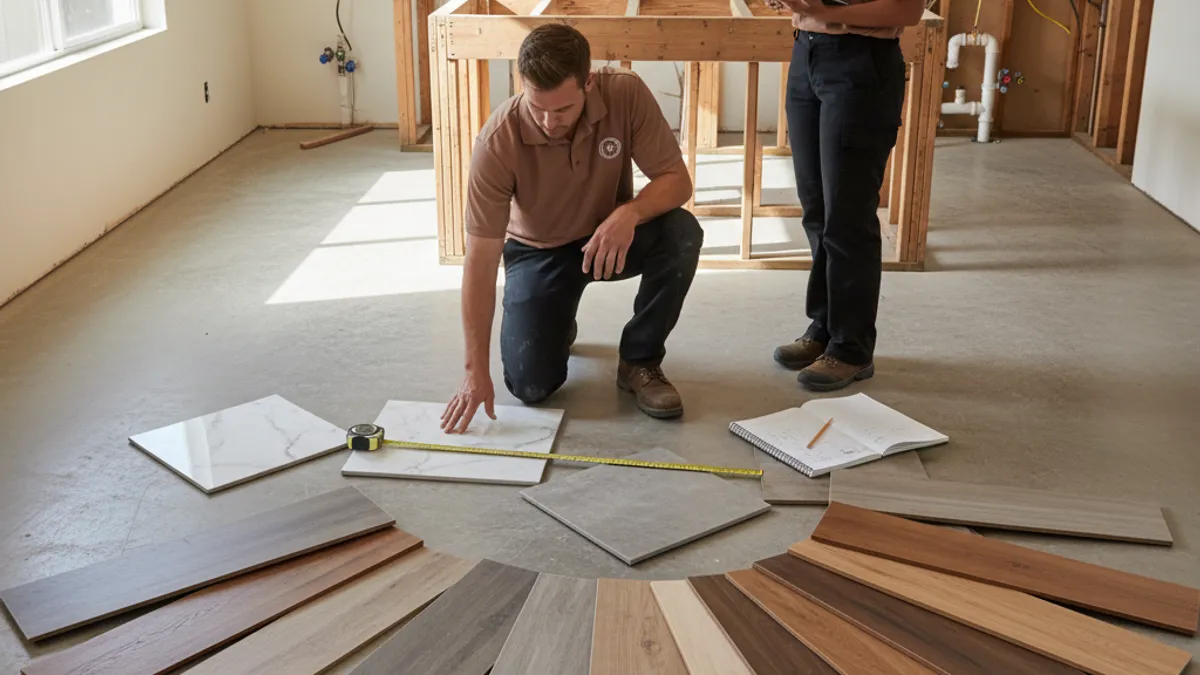
Kitchen flooring is easy to under-decide. Cabinets get a drawing. The slab gets a yard visit. The floor often gets a small sample and a hope that it will look the same in a working kitchen. It won’t, unless the product, the substrate, and the way you cook all match.
This page does not publish a San Diego installed price, a lifespan, or a moisture cutoff. Those figures change by product and by the maker’s current instructions. The useful work is picking a floor the way an installer has to install it.
Start with the kitchen you actually have
A Clairemont ranch on a crawlspace, a Chula Vista slab, a Downtown condo, and an Encinitas house with a marine-layer morning are not the same flooring job. Ask the installer to record:
- Subfloor type: slab, plywood over crawlspace, or another assembly
- Whether the kitchen floor will meet an existing living-room floor
- Where water actually shows up: sink, dishwasher, fridge line, and exterior doors
- Pets, dropped cookware, and how often the floor gets wet-mopped
- Whether cabinets stay, get refaced, or come out
If the floor is part of a larger project, read it against the full kitchen remodel sequence. Cabinet toe kicks, dishwasher height, and transitions all depend on the finished floor thickness. Our kitchen flooring page is the matching path for this trade.
Building permits may be required depending on the wider scope. Flooring by itself is not a reason to invent a City of San Diego trigger. Confirm the project with Development Services at 619-446-5000 when the address is in the city, or with the authority for that address elsewhere in the county.
Decision table: water, pets, continuity, repair, substrate
Use this table to compare products. Fill it from the current product sheet and the installer’s written method, not from a showroom label.
| Decision | What to verify before you buy |
|---|---|
| Water | Whether the product and its seams are approved for a kitchen wet zone, and what the maker says to do after a standing leak at the dishwasher or sink |
| Pets and impact | Wear, scratch, and dent information on that exact SKU, plus whether chairs, dog nails, and dropped pans are in-scope for the finish |
| Continuity | Whether the same product is approved for every room it would run through, and how its height meets the adjacent floor |
| Repairability | Whether a single plank, tile, or board can be replaced in place, or whether a leak means a larger tear-out |
| Substrate | Subfloor type, the maker’s moisture and flatness tests, the named underlayment or membrane, and who owns those tests |
If a seller cannot fill a row, that product is not ready to order. A sample that looks right in the store does not answer water, repair, or substrate.
LVP, porcelain, and wood products
Luxury vinyl plank, porcelain tile, and engineered wood are the three kitchen conversations most San Diego homeowners have. None of them is automatically the right floor.
LVP. Ask for the product name, wear-layer spec, locking or glue method, and the rooms the maker approves. Waterproof at the plank is not the same as a sealed kitchen after a slow leak under a dishwasher. Direct sun on a west-facing Mira Mesa or Carlsbad kitchen is a fade question for that SKU, not a generic vinyl rule. Cheap and premium lines are different products. Compare sheets, not the category.
Porcelain tile. Confirm the exact tile is rated for floor use. Format, grout joint, and lippage control come from the tile sheet and the installer, not from a “wood-look” photo. A large-format tile can show a floor that is not flat. Radiant heat, if you want it, has to be a listed assembly with that tile and that membrane. Porcelain is hard underfoot. That is a comfort choice, not a defect.
Engineered wood. Real wood wear layers and wood-look vinyl are not interchangeable. Engineered products still have moisture limits in the install guide. A dishwasher leak can ruin a wood kitchen floor even when the same product is fine in a hallway. If you want wood in the kitchen because the living room is wood, say so in the quote and accept the maintenance and leak risk the maker publishes.
Solid hardwood, laminate, polished concrete, and natural stone can belong in a kitchen when the maker and the installer both approve that use. They are not automatic rejects, and they are not automatic upgrades. Marble etches. Some laminates swell at edges. Concrete is hard on dropped glass. Those are reasons to read the care sheet, not reasons to invent a local failure rate.
Substrate, moisture, and underlayment
Floors fail when the substrate and the product sheet disagree.
Ask the installer to follow the product’s current installation instructions for moisture testing, flatness, acclimation, and underlayment. This page will not publish a moisture percentage, a flatness tolerance, or a countywide crawlspace rule. Coastal neighborhoods such as Ocean Beach, Pacific Beach, Encinitas, and Leucadia can have different subfloor moisture than inland Ramona, Alpine, or Valley Center. That is a reason to test the actual floor, not a reason to claim marine layer ruins a product.
Record:
- Who performs the moisture test, and which method the product requires
- What happens if the reading is out of range
- The named underlayment, vapor retarder, or tile membrane
- How transitions will be built at the dishwasher, patio door, and living room
- Whether leveling compound is included, and how added flattening will be approved
A vapor-blocking layer that the product requires is not optional insurance. Skipping a required layer can void a warranty. Adding a layer the product forbids can do the same. Follow the sheet.
Matching the kitchen to the rest of the house
Three layouts show up in San Diego remodels.
Continuous flooring. One product runs from the entry through the kitchen into the living room. It looks quiet and it simplifies transitions. It only works when that product is approved in every room it crosses, including wet kitchen zones.
Flush transition. The kitchen is a different product from the living room. A custom reducer or a well-planned T-molding can sit at one height. Off-the-shelf transitions look like off-the-shelf transitions. Ask to see the profile in the actual doorway or open-concept opening. If a wall is coming out, plan the floor with the open-concept kitchen wall removal drawings, not after demo.
A defined kitchen field. A band of tile or stone at an island or old wall line, with another product beside it, is a design choice. It costs extra coordination. It can also make a leak easier to contain. Put both products, both install methods, and the joint on the drawing.
Do not order kitchen flooring from a living-room leftover without checking height, expansion, and wet-zone approval.
Quotes without a fake county average
No verified San Diego County installed price for LVP, porcelain, or wood kitchen floors appears in the approved research for this page. We will not invent one. The independent installer prices the measured room, the product, the prep, and the transitions.
A useful quote names:
- Product, SKU, quantity, and extra material for cuts
- Removal and disposal of the existing floor, if included
- Substrate prep, leveling, moisture testing, and underlayment
- Transitions, reducers, and appliance or cabinet sequencing
- Radiant heat or other add-ons, if any, as listed assemblies
- What a later leak or a failed moisture test does to the price
Give every installer the same room measurements, product shortlist, and photos. Compare those documents, not a square-foot number overheard at a tile shop.
Before hiring, verify the contractor through the CSLB License Check. License status is legal standing, not a flooring warranty. For covered California home improvement contracts, Business and Professions Code §7159 limits the down payment to $1,000 or 10 percent of the contract price, whichever is less.
When to call us
Call when kitchen flooring has to meet cabinets, appliances, or an adjacent room, and you want a licensed remodeler to inspect the substrate and write a product-specific scope. Modern Kitchen SD matches San Diego County homeowners with licensed, independent local professionals. Call us at (858) 400-4623 and we’ll connect you with a licensed local kitchen remodeler.