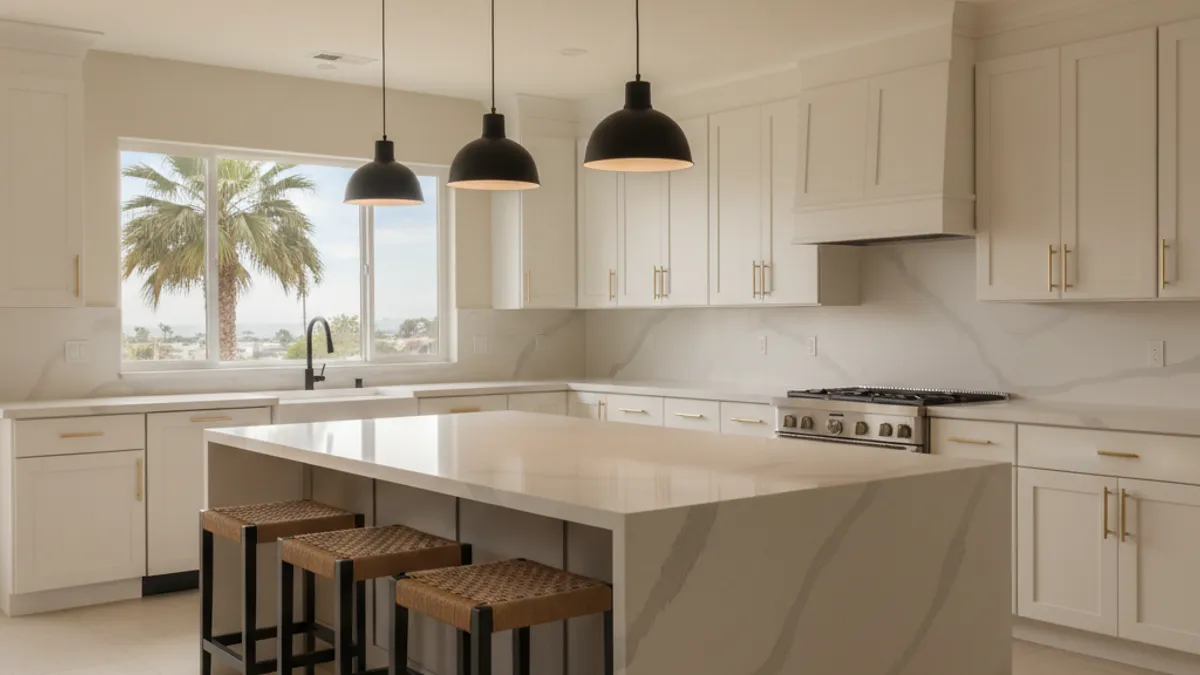
A kitchen island earns its floor space when the aisles around it still work. It wastes that space when the sketch comes first and the tape measure comes later. Draw the room. Subtract the cabinets. Then decide what the island is for.
The figures below come from the NKBA Kitchen & Bath Planning Guidelines. They are designer recommendations. They are not California electrical code, not a permit, and not a promise that a 42-inch aisle will feel comfortable in your house. The drawings, the appliance documents, and the local reviewing authority still win.
Measure the leftover aisles
Use inches.
- Measure the full width between opposite walls or fixed obstructions. Call it W.
- Subtract the occupied depth of each perimeter run, including the counter. Call those A and B.
- Subtract the proposed island depth, including its counter. Call it I.
- What remains is combined aisle space: W − A − B − I.
- If the island is centered, each aisle is that remainder divided by two.
The same math as our island vs peninsula page:
WALL |  RUN A  |  AISLE C1  |  ISLAND  |  AISLE C2  |  RUN B  |  WALL
     |<-- A -->|<--- C1 --->|<--- I -->|<--- C2 --->|<-- B -->|
W = A + C1 + I + C2 + B
Two labeled examples. They are illustrations, not a San Diego housing survey.
Example 1, a 12-foot (144-inch) room. Perimeter runs occupy 24 inches each. Proposed island is 36 inches deep. Remainder: 144 − 24 − 24 − 36 = 60 inches. Centered, each aisle is 30 inches.
Example 2, a 16-foot (192-inch) room. Same 24-inch runs and 36-inch island. Remainder: 192 − 24 − 24 − 36 = 108 inches. Centered, each aisle is 54 inches.
NKBA Kitchen Planning Guidelines recommend:
- Work aisle at least 42 inches for one cook, 48 inches for multiple cooks, measured between counter fronts, tall cabinets, and appliances
- Walkway at least 36 inches where the path is traffic, not a primary work aisle
- No work-triangle leg shorter than 4 feet or longer than 9 feet
- No work-triangle leg cutting through an island or peninsula by more than 12 inches
Example 1 fails as a two-sided work aisle if you apply those work-aisle figures. Example 2 clears a 48-inch multiple-cook aisle if the island stays centered and the occupied depths stay at 24 inches. Change any of those inputs and redo the math.
Tape the footprint on the floor. Open the refrigerator, oven, dishwasher, and island drawers. Sit in the stool positions. If two people cook, both should be able to pass without turning sideways.
Work triangle, then island function
The triangle is the path among sink, range, and refrigerator. It is a planning tool, not a law. See kitchen work triangle for how to test it against real movement.
Don’t add a sink or cooktop to an island only to make the diagram pretty. Pick two or three jobs the island will actually do:
- Prep and seating. Drawers and trash on the cook side, knee space on the other.
- Cook. Range or cooktop in the island, with a vent path the structure can accept.
- Cleanup. Prep sink or dishwasher, only if supply, drain, and dishwasher doors fit.
- Storage. Drawers and a pantry pull-out when seating is secondary.
- Beverage. A smaller footprint with cold storage, only if the aisle math still holds.
An “everything island” stacks plumbing, ventilation, seating, and storage until the aisles and the triangle both break. If the room can’t support the function, cut the function or skip the island.
Seating is its own drawing
NKBA seating guidelines (planning recommendations):
- 30-inch-high surface: 24 inches wide and 18 inches of knee space per diner
- 36-inch-high surface: 24 inches wide and 15 inches of knee space
- 42-inch-high surface: 24 inches wide and 12 inches of knee space
- 32 inches behind the seat if no one walks there
- 36 inches to edge past a seated person, 44 inches to walk past
Don’t count seats from counter length alone. A 96-inch island does not automatically seat four if a refrigerator door or a walkway eats the last stool.
If accessibility is part of the project, the 2010 ADA Standards for Accessible Design, section 804, set kitchen technical criteria for covered kitchens. In dwelling units that must comply with 809, section 804.3 requires at least one 30-inch-wide work surface at 34 inches maximum height, with clear floor space and knee and toe clearance. Section 804.2 uses 40 inches minimum in a pass-through kitchen and 60 inches in a U-shaped kitchen. Those standards do not automatically apply to every private remodel. Ask the designer which accessibility standard, if any, this dwelling must meet.
Utilities after the footprint, not after the cabinets
Plan electrical, plumbing, gas, and ventilation on the same drawing as the island box. Don’t treat a blog circuit count as California code. Current kitchen electrical details, including receptacle counts and circuit ratings, could not be confirmed in this site’s claims ledger. A licensed electrician and the reviewing authority set those requirements for the project.
If the island has a cooktop or range, California’s Title 24 Building Energy Efficiency Standards regulate kitchen ventilation. Specific CFM figures are not confirmed here. Check current standards with the California Energy Commission and the project professional. A downdraft or a ceiling hood is a duct and makeup-air problem, not a furniture choice.
Hot and cold supply and a drain for a sink or dishwasher have to reach a freestanding cabinet. So does any gas line. Those routes go through the floor or crawl space before the slab and cabinets close. Adding a sink after the top is on is a tear-out, not a small change.
Building permits may be required depending on the scope. For a City of San Diego property, contact Development Services at 619-446-5000. Some plumbing and mechanical work may qualify for a Simple Permit. The city decides that, not this page.
Materials and edges from the people who make them
Match or contrast the island top with the perimeter because you tested samples, not because a darker island is “what people do.” Quartz care follows the slab maker. Natural stone care follows the Natural Stone Institute. A waterfall end is a fabrication detail. Price it on the quote. A San Diego add-on range for that edge could not be confirmed.
End panels should be on the elevation: finished sides, appliance panels, or stone returns. An unfinished box facing a living room is a scope miss, not a style.
Seating edges and corners belong on the fabricator drawing. Comfort is the overhang and the radius you can feel with a stool pulled in, not a default profile name.
When to skip the island
Skip it when the measured aisles fall below the planning figures you and the designer are using as work aisles. Skip it when a window, a load-bearing post, or a door swing occupies the only place the box could go. Skip it when one cook needs the perimeter more than the household needs a center object.
A peninsula, a table, or a parked cart can add a surface without two failed aisles. Galley rooms are the usual place this decision shows up. See galley kitchen layout fixes and galley kitchen remodel.
Lighting over the island is a separate plan. Use kitchen island lighting after the footprint is taped.
What the quote should itemize
A current San Diego island price could not be confirmed. Modern Kitchen SD doesn’t set project prices. Compare written scopes that include:
- Cabinet boxes, drawers, panels, and interiors
- Countertop, supports, edges, and overhangs
- Electrical, plumbing, gas, and ventilation work
- Flooring patch and finish around the new box
- Lighting tied to the island
- Permit responsibility when permits apply
For home improvement contracts covered by California Business and Professions Code §7159, the down payment is capped at $1,000 or 10 percent of the contract price, whichever is less.
Kitchen design is the measured-plan step. Kitchen island build is the construction match once the footprint is honest.
Verify the contractor on the CSLB License Check.
When to call us
Call when you want a licensed kitchen remodeler to measure aisles, tape a footprint, and say whether the island you want will still leave a working kitchen. Building permits may be required depending on the scope. Call us at (858) 400-4623 and we’ll connect you with a licensed local kitchen remodeler.