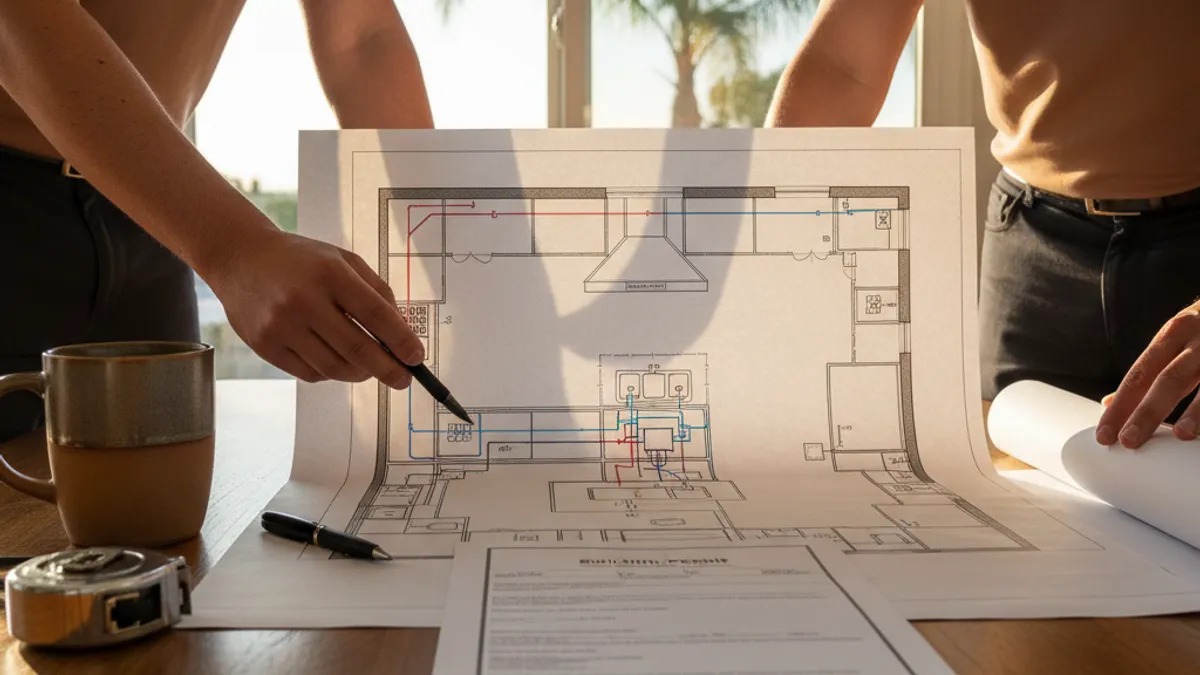
Building permits may be required for a kitchen remodel depending on the scope of work. The City of San Diego does not publish a kitchen-specific trigger list we could verify, so this page does not invent one. A contractor who waves off questions about plumbing, electrical, gas, or structure is asking you to skip the check, not answering it.
Confirm the actual scope with the professional who will do the work and with the building department that serves the address. For a City of San Diego property, call Development Services at 619-446-5000 or start at sandiego.gov/development-services.
Permits depend on scope and jurisdiction
San Diego County is not one permit office. A kitchen in the City of San Diego, a kitchen in Chula Vista, and a kitchen in unincorporated county land are reviewed by different departments. Fees, portals, and review times are set locally. We could not confirm a countywide fee table or a standard plan-check window, so those figures are not published here.
Describe the work in plain language: what stays, what moves, what is new. Include plumbing, electrical, gas, ventilation, windows, and any wall changes. Then ask the department whether a building, electrical, plumbing, or mechanical permit applies, and whether drawings are required.
Some kitchen work may qualify for a Simple Permit (a no-plan permit) for certain plumbing and mechanical work. That is a city process, not a blog exemption. Ask Development Services whether your scope fits it. Do not assume cabinet-only work, a backsplash, or a like-for-like appliance swap is automatically exempt.
What this page will not treat as a city rule
Lists that say “moving plumbing requires a permit” or “any new light requires a permit” sound helpful. They are still guesses unless the city wrote them. We could not verify kitchen-specific City of San Diego permit triggers, dollar thresholds, or a published list of exempt cosmetic work.
Treat any internet list, including an older version of this article, as a starting question for the department, not as the code. The same caution applies to surrounding cities. Chula Vista, Carlsbad, Escondido, El Cajon, Oceanside, San Marcos, Vista, Encinitas, Del Mar, and the County of San Diego each run their own counter. Similarity is not a copy of City of San Diego rules.
If the address sits in a coastal, historic, or other overlay, ask whether extra review applies. We could not confirm a standard extra-week count for Oceanside, Encinitas, Del Mar, Old Town, La Jolla, or Coronado. The overlay is an address check.
How to find the right department
Start with the property address, not the contractor’s office city.
City of San Diego. Development Services, 619-446-5000.
Other incorporated cities. Use that city’s building or development services desk. Do not file a City of San Diego permit for a Chula Vista or Escondido kitchen.
Unincorporated San Diego County. Use the County’s building department, not the City’s.
Ask three process questions while you are on the line: whether this scope needs a permit, whether plans are required, and how inspections are requested. If the contractor will submit, still call once yourself so you hear the same answers.
California’s Title 24 Building Energy Efficiency Standards regulate kitchen ventilation. For ventilation questions that are energy-code questions, the Energy Code Hotline is 800-772-3300, or start at the California Energy Commission. Do not copy a CFM number from a remodel article.
Inspections: ask for the sequence, do not guess it
A common error is mixing up rough and final. Rough work that will be covered (inside walls, under floors, above ceilings) is usually checked before it is closed. Finish work is checked later. We could not verify a City of San Diego rule that a final inspection must be signed off before cabinets are set, and we will not tell you to schedule it that way.
Ask the contractor, in writing:
- Which permits are being pulled, by name
- Whose name is on each permit
- When each inspection is requested relative to drywall, cabinet set, and fixture trim
- Who meets the inspector
If you are paying someone else to do the work, ask whose name will be on the permit, why, and what that makes you responsible for with the city and with insurance. We could not confirm a city-wide ban on owner-builder kitchen permits, and we could not confirm that the contractor’s name is always required.
Records, resale, and insurance: what we could not confirm
Keep copies of applications, issued permits, inspection cards, and approved drawings with the project file. Future buyers, lenders, and insurers may ask what work was done. That is a records habit, not a prediction.
We could not confirm that a title search always uncovers unpermitted kitchen work, that a lender always requires a retroactive permit before closing, or that a retroactive fee is a fixed multiple of the original fee. We also could not confirm that a homeowner’s insurer will automatically deny a kitchen fire, flood, or electrical claim solely because work was unpermitted. Ask your title company, lender, and insurer what documentation they want. Do not treat a blog multiplier as their policy.
The next remodel is easier when the last one left a paper trail. Permitted work has a record. Unpermitted work is a black box the next crew has to open.
What to ask a contractor about permits
Three questions separate a clear scope from a shrug:
- Which parts of this kitchen, if any, need a permit in this jurisdiction, and how did you confirm that? “We never need one” is not an answer. “I called Development Services about this scope” is.
- Whose name will be on the permit, and who schedules inspections? Verify the contractor’s license at the CSLB License Check before you sign. License status is legal standing, not a workmanship guarantee.
- When is concealment inspected relative to drywall? If the plan closes walls around plumbing or electrical, that inspection belongs on the schedule before the walls close.
For covered California home improvement contracts, Business and Professions Code §7159 caps the down payment at $1,000 or 10 percent of the contract price, whichever is less, and sets cancellation notices. Read the statute and the contract together.
A full kitchen remodel should name permits and inspections in the scope. If a wall is coming out, the open concept kitchen page is the matching service, still subject to what the city says about that wall.
When to call us
Call when you need a licensed, independent remodeler who will take the permit question to the right department instead of answering it from memory. Modern Kitchen SD is a referral service. We do not pull permits, employ crews, or inspect work. Call us at (858) 400-4623 and we’ll connect you with a licensed local kitchen remodeler. For a City of San Diego address, keep Development Services at 619-446-5000 in the same conversation.