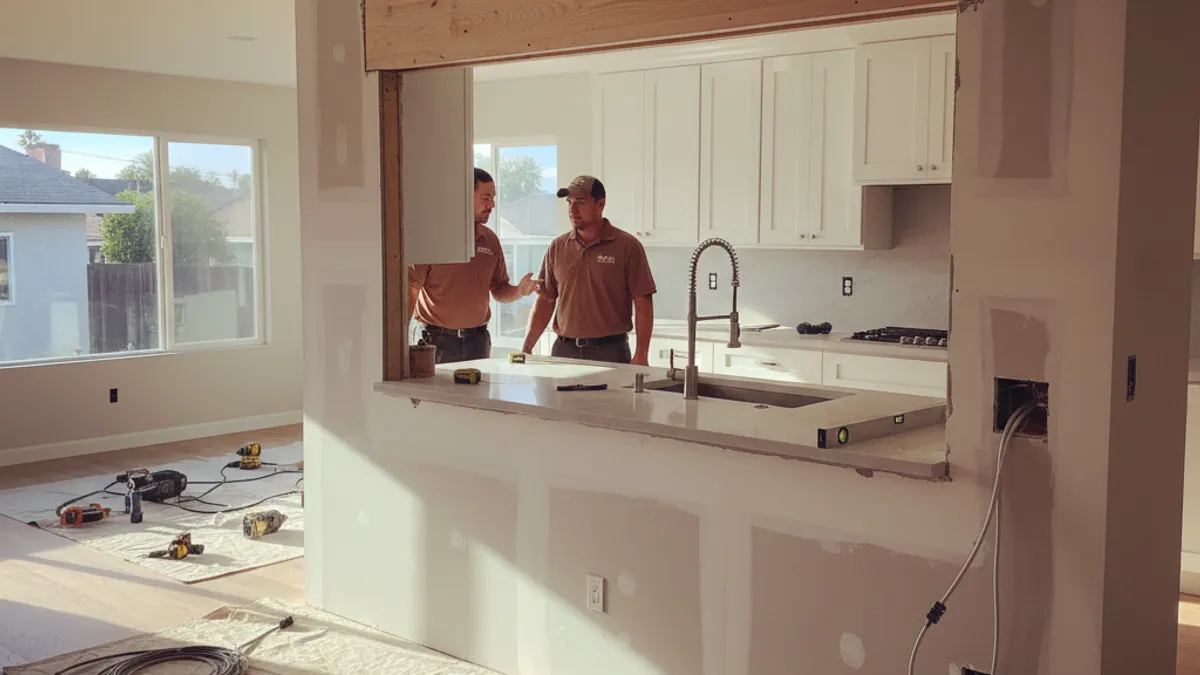
You can’t tell whether a kitchen wall is load-bearing from a blog checklist. A wall that looks decorative can still carry roof, floor, or beam load. A wall that looks heavy can still be a partition. The only safe call is a qualified assessment of the actual house, then a written plan for whatever has to replace that wall.
An open-concept conversion in San Diego is a sequence, not a demo-day surprise. The kitchens that work treat structure, utilities, permits, and finish work as one project. The kitchens that fail treat the wall as a line on a rendering.
What you can notice and what you cannot decide
Homeowner clues are useful because they tell a remodeler where to look. They are not a diagnosis.
Look at what the wall is doing in the house. Does it run under a second story, a roof ridge, or an obvious beam? Does it continue in the same line upstairs or in the attic? Are there wide cracks above existing openings, sloping floors, or doors that stick near that wall? Those are reasons to stop and get the wall checked before anyone cuts.
Do not use a rule of thumb from the internet. Joist direction, a knock test, or a stud-finder scan cannot prove a wall is safe to remove. Older San Diego tract homes in Clairemont, Mira Mesa, Chula Vista, and El Cajon have additions, prior remodels, and hidden headers that a visual guess will miss. A condo or a hillside house in coastal North County can hide a different load path than a one-story ranch.
A licensed contractor can open a small inspection point, review available plans, and say whether a structural engineer needs to stamp a new beam, posts, and bearing. The engineer, not a blog, sizes that beam. If the wall is only a partition, the written scope should still say how the opening will be framed, how utilities will move, and how the finishes will meet.
Modern Kitchen SD does not inspect walls or stamp drawings. We match San Diego County homeowners with licensed, independent kitchen remodel professionals who can bring in the right assessment.
Plan the opening before anyone cuts
Lock the design only after the wall’s job is known. Three questions have to be answered first:
- What load, if any, does the wall carry?
- What plumbing, electrical, gas, vent, or low-voltage runs are inside it?
- What finish sits on the other side, and how will the new opening meet that room?
Those answers change the cabinet layout, island placement, flooring run, and lighting. A full kitchen remodel that assumes a missing wall, then discovers a drain line or a required post, is a redesign. Our open concept kitchen service page is the matching path for this scope.
Write the opening width, the finish height, and whether any post or boxed column is acceptable. A flush ceiling beam and a boxed post are different rooms. Decide that with the drawings, not after the drywall is gone.
If the wall is load-bearing, the stamped design is the construction document. Temporary support, beam type, bearing points, and foundation checks belong there. Do not copy a beam size from another house.
Permits and who confirms them
Building permits may be required depending on the scope of work. We could not confirm a kitchen-specific wall-removal trigger from the City of San Diego’s published online material, so this page will not invent one. “Removing any wall requires a permit” is not a claim we can publish.
For a property inside the City of San Diego, the contractor or the homeowner should confirm the proposed scope with Development Services at 619-446-5000. For Carlsbad, Chula Vista, El Cajon, Escondido, Vista, or unincorporated county land, confirm with the authority that issues permits for that address. Portal names, fees, and plan-check times are set by that jurisdiction, not by a countywide average.
If an engineer stamps a beam, that letter and the drawings go with the permit application. If the wall is not load-bearing, the contractor should still ask the jurisdiction what submittal, if any, that opening needs. Some kitchen work may qualify for a Simple Permit for certain plumbing or mechanical parts of the job. That is a scope question, not a DIY classification.
Do not schedule demolition on a verbal “we don’t need a permit.” Put the permit path in the written proposal, including who pulls it and who meets the inspector.
What’s inside the wall
Kitchen-to-living-room walls often carry more than studs and drywall. Sink supplies and a drain, a range circuit, lighting, low-voltage wiring, a vent, or a gas line can all sit in that cavity. Each run has to be traced, capped, or rerouted before the wall comes down.
The remodeler should say who does that work and in what order. A licensed plumber handles water and drain relocation. A licensed electrician handles circuit relocation. Gas work belongs with a qualified professional and the serving utility’s current rules. This page will not publish pipe sizes, circuit ratings, or SDG&E sizing shortcuts. Those come from the fixture, the code cycle in force at the address, and the utility.
Reroutes happen before finish demolition, not after. A kitchen without a working sink or range for part of that work is a planning fact the homeowner needs in writing. A sloppy drain or vent shows up later as a slow sink or a sewer-gas smell. Ask how the new route will be tested before the wall is closed.
The other side of the wall matters too. A closet, hallway, or different floor finish changes the reroute path and the patching. Photograph both sides before demo so the finish plan has a record of what was there.
Frame, floor, drywall, and trim
Once the opening is legal to make, the framing follows the approved design. Temporary support stays in place until the new beam and bearing are set. Concealed posts, if the engineer calls for them, get boxed so they read as architecture or cabinetry, not as leftovers.
The finish work is what makes the missing wall look intentional.
Flooring. Decide whether the kitchen and living room become one surface. The same product can run through the opening with no threshold when both rooms can take that product. A flush reducer or saddle is the honest choice when the living-room floor stays and the kitchen floor changes. A decorative strip at the old wall line is a design choice, not a structural one. Coordinate this with the kitchen flooring plan before cabinets are ordered.
Ceiling and walls. The drywall at the new opening has to meet the existing ceiling texture. Many San Diego homes have a smooth, orange-peel, or knockdown finish. A sample board in the actual light is how a crew matches it. A bad texture match is the complaint people live with, and it is avoidable if the scope names the repair area and the paint break.
Trim. The ends of the old wall leave two vertical conditions. Painted casing, a craftsman-style head, or a boxed pilaster can make the opening look designed. Ask to see that detail on the drawing. A raw drywall return is a different look and should be a choice, not a leftover.
Keep punchlist items specific: paint touch-up, casing gaps, floor transitions, and door or window trim that the opening changed. A walk-through with photos beats a vague “we’ll come back.”
Inspections, contracts, and the work you can check
The jurisdiction, not a blog, sets the inspection list. Do not close walls until the required rough inspections are done. Do not treat a final sign-off as a date you can invent. Ask the contractor which inspections apply to this scope and who will be on site for them.
Before hiring, verify the contractor through the CSLB License Check. The tool confirms legal license status. It does not guarantee workmanship. Read the written scope for engineering, demolition, reroutes, framing, drywall, flooring, paint, and debris.
For covered California home improvement contracts, Business and Professions Code §7159 limits the down payment to $1,000 or 10 percent of the contract price, whichever is less. The statute also sets cancellation notices. Review the current law and the contract before you pay.
We could not confirm a San Diego County price for wall removal, engineering, or a full open-concept remodel. The independent professional sets the number after seeing the wall, the utilities, and the finish plan. Compare matching scopes, not a guessed range.
When to call us
Call when a kitchen wall stands between the room you have and the room you want, and you need a licensed remodeler to find out what that wall is doing. Modern Kitchen SD matches San Diego County homeowners with licensed, independent local professionals. Call us at (858) 400-4623 and we’ll connect you with a licensed local kitchen remodeler.